News
Something to Do
Sep 10, 2016
 “I like life. It’s something to do.” —Ronnie Shakes
Finding something to do has become a problem for many of us.
Almost eight million people had nothing to do in August, and that is only counting the unemployed who were looking for work. One point seven million more had given up looking. Another 6.1 million, involuntarily employed part-time, did not have enough to do.
Perhaps the most telling statistic is this one: 37.2 percent of Americans who might be working (the so-called labor force) are not. No doubt some are the stay-at-home helpmates of CEOs or the offspring of seven-term senators. Still, that figure has been steadily increasing since its low of around 33 percent 20 years ago. (Source for all the above: Bureau of Labor Statistics (.pdf).)
The situation is certain to become worse, and rapidly, owing to several factors. The Big Two are globalization and mechanization. Globalization will continue to move low- and medium-skilled jobs overseas and, increasingly, highly skilled jobs as well. Mechanization of manufacturing and service sector jobs is about to skyrocket, owing to the increasing speed and capacity of computers and the maturation of robotics.
Additionally, merger mania, with its emphasis on downsizing and layoffs; an aging population that stays on the job longer while still receiving retirement benefits that must be paid for through current F.I.C.A. contributions; and substandard health and education infrastructures that are driving down our standing in relation to both our allies and our antagonists are three more stressors on the labor force in addition to the Big Two.
It is arguable that a machine ought to do any job of which it is capable, freeing up the human for higher-level pursuits. That may be true, but between globalization and mechanization, it is all happening too fast, as the labor force participation rate so graphically reveals. And as for programs to retrain the out-of-work, they are few, underfunded, and of questionable value. You may attempt to train a 50-year-old laid-off coal miner to program in Python, but your success rate is not going to be anything to write home about.
On the other end of the work force, our children are not being trained today for tomorrow’s jobs. A K-12 school system in New Hampshire with which I am familiar has no computer science courses, or any plan to offer them. If there is one area of employment in which we may reasonably expect humans will be involved in 50 years it is in configuring, programming, managing, and repairing these beasts that will have by then relieved us of all sorts of work we do today. Not to prepare our children for that will, one day, be looked on as an unforgivable sin of omission.
What are people going to do? What should we be doing to ensure they have meaningful and remunerative work and, even more importantly, are ready to perform it? Probably a great deal more than we are doing now, or even talking about doing now.
I wrote a piece here entitled “Make America Work Again” in May. There I noted that over half of working Americans do not make enough to live on. But at least they are working. Increasing numbers of us are not, however, and our polarized and paralyzed political system holds out little hope for effective action at this time.
If any of us are to continue to have something to do, we must do something. And now.
Make America Work Again: Our Employment Crisis
May 30, 2016

We are in the midst of an employment crisis in this country. Too few people are employed and too many who are earn less—sometimes far less—than enough to live on.
Nearly eight million people were on the unemployment rolls in April. [1] Only 62.7% of Americans of working age are employed or looking for work, the lowest percentage since 1978, [2] and this does not include the nearly 600,000 who have given up looking for work.[3]
Additionally, around three million people who are working earn at or below the minimum wage, which has been $7.25 at the federal level since 2009. [4] Living wage calculators at MIT [5] and the Economic Policy Institute [6] both indicate that $7.25 is less than one-third of a living wage for an adult with one dependent child living in Vermont or New Hampshire. Millions of other workers earn more than the minimum wage but much less than these calculated “living wages.” Almost half of all American workers earn less than the inadequate $15 per hour currently called for by various activists and politicians. [7]
Finally, around six million working people are involuntarily employed part-time and also probably earning well below a living wage. [8]
People need to work, and when they don’t, or when they work for less than a living wage, those of us who do work and earn a living wage are unfairly called upon to pick up the hefty slack, while employers reap the benefits, often, as in the case of the Walmart heirs, becoming multibillionaires in the process.
A recent study by the Center for Labor Research and Education at UC/Berkeley [9] determined that a mere four social welfare programs, the Earned Income Tax Credit, Temporary Assistance to Needy Families, Supplemental Nutrition Assistance Program, and Medicaid cost $152 billion a year between 2009 and 2011. That is almost half a trillion dollars in only three years. Over half that assistance went to working families. And there are dozens of other taxpayer-funded federal, state, and local programs in addition to these.
How long would a business that only paid a third of its electric bill or half the cost of its raw materials remain open, or deserve to? And yet Walmart, only the largest employer to pay their workers less than a living wage, goes on growing year after year. Forbes magazine reported in 2014 that Walmart alone cost taxpayers about $6.2 billion a year in public assistance. [10]
We need to forge a new social contract with ourselves, setting out our rights and responsibilities. The two most important elements on the rights column would be an adequate education and a job that paid a living wage. Every U.S. citizen and legal resident should be guaranteed both. And in the responsibilities column?: Perform your job to the best of your ability and be a good citizen.
Then we can dismantle all these expensive, inefficient, ineffective, and humiliating “safety net” programs and let people enjoy the independence of which we are (almost) all capable. Those few who can’t work could be cared for. Those who can work and won’t, well, good luck to them.
When almost everyone is working and receiving a living wage, almost everyone will be paying into our shared tax pool instead of siphoning funds out of it. Tax revenue up; social “welfare” expenses down; lower taxes for all of us to pay.
Before any “political revolution,” we need a social revolution, one that acknowledges that although we are a liberty-loving, rambunctious, and ingenious people perfectly capable of taking care of ourselves, we are too easily tempted to let someone else take care of us if the opportunity is available.
We would all be much better off if our system encouraged, enabled, and, yes, expected us to exercise our natural independence rather than the contrary.
What individual of any political persuasion could offer a valid argument against such common sense? The left-leaning inclination to expand the safety net and the right-leaning inclination to limit such support to business and the one percenters, are both equally misguided. There is dignity in work, and there is equity when everyone, worker and business alike, pulls their own weight.
Our employment model needs to be based on the unique individualism, love of liberty, and instinct for self-reliance which has always characterized our people. It also needs to stop enabling so many of us—employer and employee alike—to be dependent on the rest of us.
But don’t take my word for it:
“This country will not be a permanently good place for any of us to live in unless we make it a reasonably good place for all of us to live in.”
Theodore Roosevelt, 26th president of the United States (1858-1919)
“It seems to me . . . that no business which depends for existence on paying less than living wages to its workers has any right to continue in this country . . . and by living wages I mean more than a bare subsistence level—I mean the wages of decent living.”
Franklin Delano Roosevelt, 32nd president of the United States (1882-1945)
“The best social program is a good job.”
William Jefferson Clinton, 42nd president of the U.S. (b. 1946)
Sources
[1] http://tinyurl.com/zpu5uv
[2] http://tinyurl.com/zpu5uv
[3] http://tinyurl.com/h37rmuj
[4] http://tinyurl.com/z6e53mp
[5] http://livingwage.mit.edu/
[6] http://www.epi.org/resources/budget/
[7] http://tinyurl.com/h2p7h2n
[8] http://tinyurl.com/zmfhsbk
[9] http://tinyurl.com/kda4v6q
[10] http://tinyurl.com/jjyv7d3
Open Letter to Bernie Sanders
Sep 26, 2015
 Bernie,
I am writing this letter to you on my page because, even though the email I received from you today says, “we need to hear your ideas as to what issues are most important to you ....” there is nowhere on your official campaign website for me to say these things to you.
It is good to see you are fleshing out your platform beyond the one-note income inequality issue with which you launched your campaign. I agree with everything in this email that sets forth your position on many issues, with the following exception:
You say, “We need to raise the minimum wage to a living wage. . .Over a period of a few years the national minimum wage should be $15 per hour.”
You need to go much further than this. For one thing, $15 per hour is not a living wage right now, let alone will it be in a few years. MIT has an excellent Living Wage Calculator which I believe originated at Penn State. It indicates that a living wage for an adult with one child in our state of Vermont is already $22.04 per hour. Now of course what constitutes a living wage must of necessity be a matter for careful study and computation. The Economic Policy Institute, for example, estimates a living wage for the same adult with one child living in Vermont at $25.71 per hour.
I hate to say this to you, Bernie, because I believe you are sincere in your campaign. However, anyone arguing for less than a living wage TODAY is playing into the hands of the corporatocracy, not to say colluding with them, to maintain a high level of poverty in this country.
I have taken the pledge not to vote for any candidate who does not support my personal platform: A guaranteed job at a living wage for any adult 18-65 who wants one. Then dismantle the huge, expensive, humiliating, and ineffective social “safety net” of alphabet programs that simply sustain dependency among a population perfectly capable of independence.
The second essential plank of my platform is real education reform. The waste of brain power in this country (and throughout our world) is a disgrace. Real reform is going to be expensive and disruptive. However, it needs to be pursued with a single-minded purpose: That ALL our children will be provided with a quality education, whatever it takes, whatever it takes, whatever it takes.
So good luck, Bernie. I don’t expect to be voting for you or anyone else in 2016, unless a candidate comes along who is truly willing to speak truth to a populace exhausted by the wretched governance that has been foisted on us since the Reagan administration. We are in a downward spiral in this country, and a $15 minimum wage in a few years is not going to slow that descent one little bit.
The Business of America Is Work
Dec 18, 2010
People have to work. They have to work for their bread. They have to work for their self-esteem. They have to work in order to take their place in a society which requires their portion of labor and which is only able to underwrite their idleness to a limited extent before it begins to crack apart.
One in every four American workers is not working now—at all or enough or at a sufficient wage to qualify them as adequately employed. They are threatening to become a permanent underclass of un- and underemployed Americans. The middle class who are employed are losing ground, losing hours, losing wages, forced by globalization to drift ever nearer to the status of the third-world neo-slave labor force that is inundating our globe with cheap goods and environmental degradation.
If we are to avoid social cataclysm, work must become the top priority in America. And the only way to do that is to guarantee every American worker a job at a living wage.
The recent tax cut legislation passed by Congress is another poison pill dropped into the social brew. That brew has been poisoned for thirty years by the nonsense of trickle-down economics, as enormous fortunes have been made by brigands with whom the robber barons of the 19th century would have been ashamed to associate. The legislation will have little or no effect on employment, which can only be bettered by finding our way back to a vibrant, productive economy. If we have to jump start that economy by governmental intervention to put people—all people—back to work, then so be it.
The fact that we should never have allowed ourselves to reach the point where such action is required is beside the point. We are there. Americans in vast numbers are losing their homes, their jobs, and their savings, and with home, job, and savings go their self-esteem and their connectedness to community. As we enter the third year of economic bust in America, huge numbers of the unemployed will begin to exhaust their 99 weeks of unemployment compensation. Cold and hunger will then visit America to an extent not felt since the first half of the 19th century. Few who feel this cold and hunger will be unjustified in believing their social contract has been broken, and we may look for a rapid decline in social order, a ramping up of police state repression, and a swift decline into third world status ourselves.
This need not be, howsoever present policies seem to be condemning us to this fate. We, the people, remain the masters of our fate. And while that is still so, we must act, with speed, decisiveness, and a spirit of cooperation not seen since the founding fathers came together from disparate political spheres to establish this grand experiment in the first place.
A Living Wage, Part 2
Sep 06, 2010
 It is immoral to take an adult’s full-time labor and pay that adult less than a living wage. It is immoral, and it should be illegal.
Given that premise, what should we do? In our previous post on this issue, we noted that the Living Wage Calculator at Pennsylvania State University1 provides a living wage (LW) for a variety of households throughout the 50 states and D.C. What a single-person household requires for an LW is obviously going to be less than a household containing two adults and two children. Furthermore, a four-person family living in rural Vermont is going to require a lower LW ($25.38 in my county) than one living in midtown Manhattan ($30.30).
Geographic variation may be taken into account in establishing an LW without fearing everyone will move to regions where a higher one is available. There are simply too many other factors involved. However, to set an LW on the basis of household size is to risk both employers and employees attemping to “game the system” to their advantage. Just as the current federal minimum wage ($7.25 per hour) is a one-size-fits-all figure, so should the estabishment of an LW. The question is, what level do we set it at? My recommendation is to set it at the level provided by the Living Wage Calculator for a household with one adult and one child.
This is something of a compromise. I grew up in the classic American family, where one breadwinner supported himself, a spouse, and two children. The average family size still hovers around that figure. From a social policy perspective, we can argue that the LW should encourage this size of a family unit. Practically speaking, however, we can never hope to raise the minimum wage from $7.25 to over $25 per hour, at least until we can demonstrate the feasibility—and desirability—of a significant, if lesser, increase.
In the real world today, most intact households contain two working adults. If we set the minimum wage at a level sufficent to support one adult and one child, we may have a reachable goal which is still a desirable one from a social policy perspective. In my rural Vermont setting, this means raising the federal minimum wage from $7.25 per hour to $15.47. As the people at Pennsylvania State University say, this figure supports “a minimum estimate of the cost of living for low wage families.” No frills here. No European vacations, and little left over for college or retirement nest eggs. This is still bare bones living and still it is over twice what we require employers to pay their full-time workers today. And if that is not a national disgrace on par with waging endless war for the sole purpose of enriching a handful of multibillionaires, I don’t know what is.
The very idea, of course, will set up a great wailing and gnashing of teeth. It will be attacked as the last socialist nail in the coffin of American freedom and capitalism. It will be hooted down as pie in the sky. However, others, more thoughtful and aware of the extent of the peril we face if we maintain the status quo, will begin to take up this cause (and you will hear about them in this column).
Now it is time to turn our attention to the other great change we must bring about—guaranteed employment for all. And with that new civil right will come new civil responsibilities. More about that in our next posting.
____________________
1 Living Wage Calculator, from Pennsylvania State University, accessed September 6, 2010.
Ending the Great Recession
Sep 04, 2010
 Another respected voice has been raised in opposition to the growing income inequality in our country.1 On the eve of another disappointing jobs report, when the official unemployment rate rose another tenth of a percent (to 9.6), former Secretary of Labor Robert Reich warns that “None of the standard [economic] booster rockets are working,” not low interest rates, cheap money, the stimulus, or tax credits for new hires.
The real problem, says Reich, is “the structure of the economy.” Consumers have run out of buying power, having seen flat wage increases since the exalted Reagan Revolution: “The median male worker earns less today, adjusted for inflation, than he did 30 years ago.” They can only make a car, a handbag, a basket of apples, so cheap, and you will still not be in a position to buy them if you are earning at a 1980 level, you have maxed out your charge cards, and your house, which you borrowed on during the years they convinced you its value would never decrease, is now underwater.
Meanwhile, no power on earth seems capable of slowing the transfer of wealth in the U.S. from the poor and middle class to the super-rich top one percent, who have gone from earning 9 percent of the nation’s total income in the late 1970s to 23.5 percent in 2007. Yes, that is one percent of the population earning nearly a quarter of all national income.
Reich takes his lesson from the Great Depression and its aftermath: “[T]here is only one way back to full recovery: through more widely shared prosperity.” In other words, through a redistribution of wealth, the sort of thing made possible in the 30s and 40s by the New Deal programs, a healthy labor movement, the G.I. Bill, and social legislation that attacked inequities in civil and voting rights. However, most of these and other such programs are still in place, and yet our wealth continues to flow up to the very few, abetted by a bought-and-paid-for political establishment.
The problem with Reich is that his recipes for relief seem paltry and all-too-easily belittled, besieged, and dismissed in the present political climate: Increasing the income tax credit, raising the ceiling on Social Security contributions, extending educational opportunities at both ends of the school career, compensating the underemployed with something he calls “earnings insurance.”
Like the stimulus and other measures floated to little or no effect so far, these ideas seem doomed to failure. In my view, we need a recall to democracy, where all for one and one for all is recognized as the only way for all to thrive.
A two-plank platform can get us there: 1) Guaranteed employment at 2) a living wage. Next time, I will get back to what I think that living wage should be.
See also two enlightened columns2,3 from yesterday’s Huffington Post.
____________________
1 How to End the Great Recession, by Robert Reich, from the NY Times, September 2, 2010, accessed September 3, 2010.
2 Neo-Progressives, by Lawrence Lessig, from the Huffington Post, September 3, 2010, accessed September 4, 2010.
3 Why the Big Lie about the Job Crisis?, by Les Leopold, from the Huffington Post, September 3, 2010, accessed September 4, 2010.
A Living Wage, Part 1
Aug 28, 2010
So what is a living wage (LW)? I am happy to let anyone establish that figure, if they are willing to live on it for the next two years. Hands? Well, all right, we will have to arrive at an LW by a different path.
Pennsylvania State University has developed a Living Wage Calculator1 which is probably as good a place to start as any. They provide living wages for a single adult, an adult with one dependent, two adults, two adults with one dependent, and two adults with two dependents. In a drastically overpopulated world, I would argue that we need not go beyond these numbers in our guaranteed LW. If you want to burden the world with six children, you had better be prepared to pay the price.
In my neck of the woods (Windsor County, Vermont), the LW for a single adult is $8.38, $1.13 more than the federal minimum wage and $.32 more than Vermont’s more generous minimum wage. An LW for an adult supporting a spouse and two children is $25.38 per hour, $18.13 more than the federal minimum wage and $17.70 more than Vermont’s minimum. At that level, the difference in the shortfall between the two is negligible.
Which brings us to our first practical problem. What is to keep employers from favoring hiring single adults without children if we establish these living wages based on marital and dependent status? What employer would not rather spend $8.38 than $25.38 per hour on an employee? And from the other point of view, would not the prospect of a significantly higher wage motivate many to have children who would otherwise not want them and who, consequently, probably shouldn’t have them?
I will propose one solution to this conundrum in my next posting. Follow me on Twitter to find out when that will be.
____________________
1 Living Wage Calculator, from Pennsylvania State University, accessed Aug 28, 2010.
A Modest Proposal
Aug 22, 2010
 Among thoughtful observers, a consensus seems to be forming regarding the only way out of the nasty mess(es) we are in, and that consensus is jobs. We need to put people back to work, and fast. Read the essays by Bob Herbert and Bob Burnett linked on this month’s Noted with Interest for starters, then search "jobs" in Google News for the past 24 hours and read many more.
Employment, in my view, should be a right, embodied in a constitutional amendment, along with the other rights we hold so dear.
The right of all adults to have a job and to be free from the vicissitudes of unemployment can and should be realized in this country, though to do so will require a sea change in our attitudes and a huge shift in priorities, away from a government of, by, and for corporations and back to a government of, by, and for the people—that is, back to a democracy instead of the corporatocracy which now controls our nation, our state and federal governments, and you and me.
We are a rich nation only at the very top of income levels. Otherwise, we are a poor country that is getting poorer under the thumb of the corporatocracy. Over thirteen percent of Americans—39.8 million of us—lived in poverty in 2008 and that number has gone up since then.1 This includes nearly one in five children, the highest rate of childhood poverty—by far—in the industrialized world.2
An essential step before guaranteeing employment for every American adult is to ensure that those jobs will pay a living wage.3 The federal minimum wage, forty years ago, was not even close to a living wage and today it is significantly further from one. It is past time to acknowledge that it is immoral to accept an adult worker’s full-time labor and pay that worker less than a living wage. It is immoral, and it ought to be illegal. So this is step one on the road to full employment—every job in America must pay a living wage.
In my next post, I consider what should be included in computing a living wage. Meanwhile, click on footnote #3 to find out what a living wage is in your state (according to one university’s calculations), and footnote #4 to find out your state’s current minimum wage.4 The federal minimum wage, below which states are not allowed to fall, is $7.25 per hour.
____________________
1 U.S. Census Bureau, accessed Aug 22, 2010.
2 Safety nets for children are weakest in US, from UNICEF, accessed Aug 22, 2010.
3 Living Wage Calculator, from Pennsylvania State University, accessed Aug 22, 2010.
4 List of U.S. minimum wages, from Wikipedia, accessed Aug 22, 2010.
Compare and Contrast
Oct 14, 2009
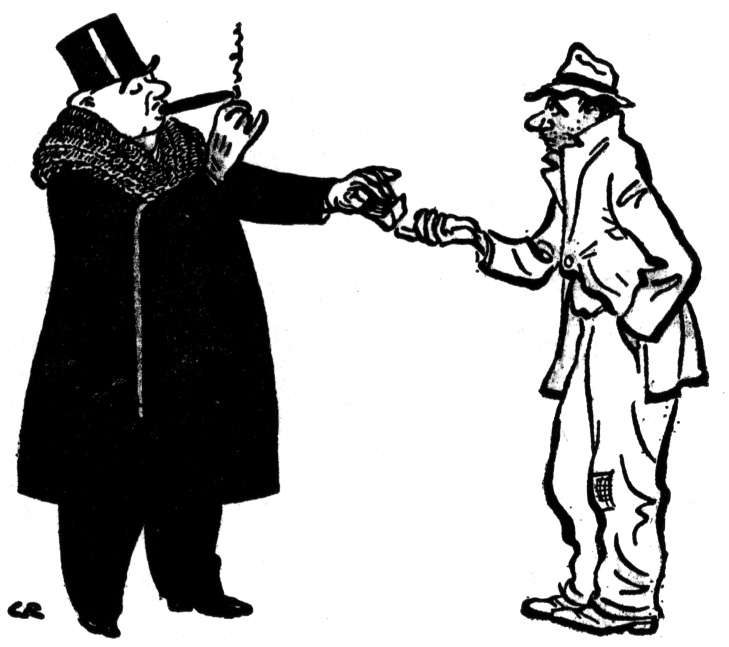 Two stories in the NY Times caught my eye today. They brought back the feeling of those old English classes in high school and college where we were invited to “compare and contrast” a pair of literary entities, such as characters in a Dickens novel or the way Fitzgerald and Dos Passos envisioned American in the 1920s.
These stories, by implication, compared and contrasted two modes of contemporary life in the U.S., and without belaboring you with my own two cents’ worth regarding their messages, I will simply link them and encourage you to read them both:
U.S. Pay Czar Tries Again to Trim A.I.G. Bonuses
and
Still on the Job, but at Half the Pay
It's Off to Work We Go
Apr 16, 2009
 Unemployment and excessive inequality are capitalism’s principal faults, according to John Maynard Keynes. These faults have become glaringly obvious in the past thirty years, when the gap between the lowest paid workers and the highest has increased tenfold or more.1 The employment crisis is more than evident to the 5.1 million who have become unemployed during the current downturn toward depression, joining millions of others who are working part time against their will or have given up looking for work altogether. Some estimate the true unemployment rate at more than 15 percent.2
Our voice, raised perhaps monotonously often in favor of the establishment of an immediate and significant federal jobs program, on a par with the Works Progress Administration or the Civilian Conservation Corps, has now been joined by the Levy Economics Institute of Bard College, in a report entitled The Social and Economic Importance of Full Employment, by L. Randall Wray.
Unemployment and excessive inequality are capitalism’s principal faults, according to John Maynard Keynes. These faults have become glaringly obvious in the past thirty years, when the gap between the lowest paid workers and the highest has increased tenfold or more.1 The employment crisis is more than evident to the 5.1 million who have become unemployed during the current downturn toward depression, joining millions of others who are working part time against their will or have given up looking for work altogether. Some estimate the true unemployment rate at more than 15 percent.2
Our voice, raised perhaps monotonously often in favor of the establishment of an immediate and significant federal jobs program, on a par with the Works Progress Administration or the Civilian Conservation Corps, has now been joined by the Levy Economics Institute of Bard College, in a report entitled The Social and Economic Importance of Full Employment, by L. Randall Wray.
The popular view holds that in a capitalist economy, a hefty contingent of the unemployed keep down the pressure for wage increases by those who are working, since there are plenty of others ready and willing to take their jobs. In addition, too-low unemployment, because it forces employers to pay higher wages to attract the best workers from a shrinking pool, is inflationary. The popular view is not only an immoral view but, according to the Levy Institute, an incorrect one as well. The Institute argues for the government taking on the role of employer of last resort (ELR), hiring “any workers not needed in the private sector or by existing government operations.”
The report goes on to refute the arguments against a federal ELR program, and offers suggestions for useful types of work, including the sort that Roosevelt provided in the 30s.
If unemployement continues to rise at anything like the rate we have seen in the last six months, we will approach Great Depression levels of actual unemployment (25 percent or more) before the end of the year. The time is now to institute a federal ELR program. It is not only morally imperative for a civilized nation to guarantee employment to anyone willing and able to work, it may be our last hope to avoid massive civil unrest and a prolonged worldwide depression.
____________________
1 Income inequality in the United States, from Wikipedia, accessed Apr 11, 2009.
2 Shocking truth: The real unemployment rate is is much higher, by Steve Crist, from the Burlington (VT) Examiner, Apr 7, 2009, accessed Apr 22, 2009.
Jobs Now!
Apr 08, 2009
 More bad news in March: 663,000 more people lost their jobs. Buried under the fold in the Bureau of Labor Statistic’s monthly report,1 was the not unexpected revelation that January’s job loss figures had been revised upward from 655,000 to 741,000. We noted the BLS’s habitual tendency to come in with unrealistically low estimates of job losses in Hey, Buddy, Can You Spare a Job? So we will probably have to wait a couple of months to find out the true damage in March.
While we wait, let us note that almost three-quarters of a million people lost their jobs in the first month of 2009, and over 1.3 million have lost theirs since—numbers that should be striking a great deal more terror into the hearts of our body politic than they seem to be. The 1.2 to 3.3 million jobs the stimulus package is supposed to create over the next two years (according to the Congressional Budget Office2) already falls far short of the five million plus that have been lost during this recession already, and the monthly losses keep accelerating.
Also little acknowledged are the recent startling increases in bankruptcies,3 even in the face of steep eligibility requirements brought to us by our compassionate corporatocracy in the Bankruptcy Abuse Prevention and Consumer Protection Act of 2005.4 Nearly 6,000 people filed for bankruptcy every day in March 2009, up 38 percent from a year earlier. If bankruptcy judges are afforded a measure of control over mortgage foreclosures and renegotiations, filings are expected to soar even higher.
These are not mere numbers, they are human lives, suddenly and violently wrenched from positions of comparative if shaky stability to wracking uncertainty and impending destitution. And it is happening to 700,000 more of us every month. What happened in Binghamton last week5 is only the most public, violent, and recent manifestation of the unravelling of our society.
Those of us still employed must come to the aid of those of us who are not. Jobs—lots of them and right away—must become our only priority. If we do not halt the hemorrhaging of employment in our society, all the bailed out bankers in the world will not save us from a rapid and precipitous descent into massive civil unrest that will threaten the very foundations of our civilization.
Bin Laden must be laughing up his sleeve in some hole in western Pakistan, as he contemplates the descent of his mortal enemies into the same primitive, lawless, and brutal existence in which his own world lays mired.
____________________
1 Employment Situation Summary, from the Bureau of Labor Statistics, March 2009, accessed Apr 4, 2009.
2 A Preliminary Analysis of the President’s Budget and an Update of the CBO’s Budget and Economic Outlook (.pdf, 1.5Mb, 56 pp.), March 2009, accessed Apr 4, 2009.
3 Downturn Pushes More Toward Bankruptcy, by Tara Siegel Bernard, from the New York Times, Apr 3, 2009, accessed Apr 4, 2009.
4 Bankruptcy Abuse Prevention and Consumer Protection Act, from Wikipedia, accessed Apr 4, 2009.
5 Shooting in Binghamton, N.Y., by Katherine Q. Seelye, from the New York Times, Apr 3, 2009, accessed Apr 4, 2009.
The Quiet Crisis
Apr 03, 2009
 The nonprofit sector of the economy constitutes 11 percent of the workforce, more than the auto and financial industries combined. They are suffering a triple whammy in the present downturn: less foundation and individual giving; diminished support from states and localities that are themselves feeling the pinch; and dramatically increased demand from the populations they serve.
In The Quiet Crisis: The Impact of the Economic Downturn on the Nonprofit Sector (.pdf, 2.6Mb, 22 pages), a joint report by Civic Enterprises and the Democratic Leadership Council, the parameters of the problem are made starkly evident:
- Churches saw a decrease of $3 to $5 billion in expected giving in the third quarter of 2008.
- United Way saw an increase of 60 percent in the calls for basic services in 2008.
- Chicago is trimming its Meals on Wheels budget by more than a third.
- Arizona saw an increase of over 100 percent in the number of people who sought social services from 2007 to 2008.
- Michigan suffered simultaneous increase in demand by 70 percent of its nonprofits while 50 percent say their financial support has declined.
- Pass the Serve America Act, a $5.7 billion program that will increase the number of AmeriCorps volunteers from 75,000 to 250,000. The Senate passed their version of this bill last week.
- Adopt a handful of tax incentives that will expand private giving and volunteering.
- Establish a fund that would produce programs to improve nonprofit management and develop new ideas and pilot programs to improve existing systems.
- Give nonprofit housing and financial institutions a prominent role in solving the nation’s massive mortgage and foreclosure problems.
Hey, Buddy, Can You Spare a Job?
Mar 10, 2009
 How do 2,789,000 job losses over the past seven months morph into 3,460,000? Well, we couldn’t say, exactly, but they did. Every month since August 2008, the Labor Department has revised its initial announcement of job losses, and the revisions have always been higher, on average by 112,000.1 You would think that the obviously imperfect art of calculating job losses, if conducted in anything like an atmosphere of political neutrality, would occasionally be too high initially, and subsequently be revised downward. Such is not the case recently, however, and on March 6, 2009, we found ourselves with 671,000 more of us out of work than was initially reported.
However you explain the rocky path to calculating unemployment, we are losing a half a million jobs a month on average, and more than 650,000 a month over the last quarter. “These jobs aren’t coming back,” opines John Silvia, chief economist at Wachovia.2 “A lot of production either isn’t going to happen at all, or it’s going to happen somewhere other than the United States. There are going to be fewer stores, fewer factories, fewer financial services operations.”
We are in a perfect storm of collapse. Businesses have no access to the lifeblood of credit in the face of the banking industry’s self-destruction and the ineffectiveness of the trillions in federal handouts and guarantees. Millions of unemployed cinch their belts another notch, and those who are still pulling a paycheck save more of it in order to bolster their decimated retirement accounts. Spending declines precipitously (17 million cars sold in 2007 and are now selling at an annual pace of 9 million).2 As spending declines, more businesses lay off more workers, spending declines further, and where does it end? If allowed to continue, nowhere pretty.
Let’s do some math. Assume there are five million people seeking work. If the government provided a job for all of them at the average weekly wage of $615.00,3 it would cost $3.075 billion a week, or $159.9 billion for one year (with much of it coming back as income tax and FICA). That is only 20 percent of the $785 billion stimulus package (universally acknowledged to be inadequate), and way less than the government has lavished on the banks to no apparent purpose. And jobs—not hedge funds, collateralized debt obligations, investment banker bonuses, unemployment compensation extensions, tax credits for home improvements, or subsidized COBRA premiums—jobs are the bedrock of any economy. Getting money into people’s pockets next week: This is where the administration should be focused.
Or this vicious circle we find ourselves in will widen, accelerate, and take us all down.
____________________
1 Will Job Numbers Keep Being Revised Down?, by Floyd Norris, from the New York Times, Mar 6, 2009, accessed Mar 7, 2009.
2 Job Losses Hint at Vast Remaking of Economy, by Peter S. Goodman and Jack Healy, from the New York Times, Mar 6, 2009, accessed Mar 7, 2009
3 The Labor Picture in February, from the New York Times, Mar 6, 2009, accessed Mar 7, 2009
The Golden Rule, Explained
Feb 16, 2009
 We harp. We know we harp. We can’t help it. Some people just don’t get it.
This morning (Feb 13), New Hampshire’s Democratic governor, John Lynch, announced 300 layoffs of state employees. What are the likely consequences of these layoffs? Presumably there will be longer lines at the Department of Motor Vehicles, and other government services will deterioriate. For the unlucky 300, the consequences will be a good deal more dire. Most people live from paycheck to paycheck. When that spigot abrubtly turns off, they will immediately dip into your pocket and mine to claim unemployment compensation.
In New Hampshire, benefits range from $32 to $427 a week for up to 26 weeks.1 For those earning from $2,800 to $41,500 a year, that benefit will be slightly more than half their gross pay. For those earning more, it will be less.
The stresses these people will suffer will be many and varied. Some will not be able to keep up with their mortgages and will be tossed out of their homes (sound familiar?). The values of those houses, now white elephants owned by the bank, will drop through the floor. If the houses are on your block, your home value will decrease as well. If it decreases enough to make your home worth less than you owe on it, you may actually be well advised to abandon it, as at present you have no leverage (or government assistance) to renegotiate your mortgage.
Besides dipping into our pockets for cash benefits and decreasing the value of our prime asset, those 300 laid-off neighbors will cease enjoying the luxury of any discretionary spending, creating a ripple effect (or perhaps we should call it a non-ripple effect) across the immediate purview of their erstwhile economic landscape, increasing the downward slide of local restaurants, movie theatres, hardware and clothing stores, etc., etc. If the effect is great enough (and remember we are talking about 2.5 million of these hapless folks just over the past five months), then many of those establishments will close, further contributing to the downward momentum toward deflation and depression.
Since those who are pretty bad off to begin with (minorities, minimum-wage earners) are generally the first to get it in the neck during an economic downturn, some will become so desperate that they will be driven to extreme measures, becoming a physical threat to their neighbors and the general infrastructure. The court system will become clogged and jails will suffer further overcrowding, requiring yet more millions in public funds.
The Golden Rule—Do Unto Others As You Would Have Others Do Unto You—is not a touchy-feely, altruistic expression of noblesse oblige. It is a survival tactic. We are either in this together or we are in this alone. If we are in this together, we do everything we can to forestall layoffs, foreclosures, and closings, and that includes cutting back for a time on what we have in order to share the temporarily diminished pie. If we are in this alone, there is really only one thing we need to do.
Buy a gun.
____________________
1 Amount and Duration of [Unemployment Compensation] Benefits, accessed Feb 13, 2009
City Lights
Nov 23, 2008
 If the Obama administration doesn’t hit the ground running, it won’t be because the cities are dragging their feet. For a measly $24.5 billion (a tenth of the amount Treasury Secretary Paulson has already handed out to banks and investment houses, although we still do not know who has gotten what, and it hasn’t made much of a difference, has it?), the cities are ready to go with 4,591 infrastructure projects in 153 cities and in ten different categories, including energy, transit, highway, airport, Amtrak, water/wastewater, public safety, and school and public housing modernization.
In a press release from the United States Conference of Mayors, they state the projects are ready to go and could be started and completed in 2009. The projects would create more than a quarter of a million good-paying jobs.1
For a complete list of projects, costs, and employment figures, see the conference’s report, Ready-to-Go Projects (.pdf).
A boost to our sagging infrastructure and some major relief for our soaring unemployment! We hope Obama is listening, and we hope Paulson hasn’t emptied the whole $700 billion purse into his cronies’ pockets by January 20.
Update, Jan 13, 2009: The Conference of Mayors has released its third report. It now has over 15,000 ready-to-go projects in 641 cities capable of producing over 1.22 million jobs.2
____________________
1 Press Release (.pdf), November 14, 2008 (Accessed November 18, 2008)
2 Press Release (.pdf), December 19, 2008 (Accessed January 13, 2009)
Your Tax Dollars at Work
Nov 10, 2008
 Over 19 million people work for local, state, and federal government in the U.S. That is over six percent of the total population—men, women, kids, retirees, everybody. And it is over 12 percent of the total civilian workforce of 154 million—one in every eight and one-third workers.1
Something just under 9 million government employees—almost half—work in local and state education.2 An additional 7.5 million work in local and state government, providing hospital and police services (slightly under 1 million each); corrections (three-quarters of a million); highways and public welfare (half a million each); and a host of other services at lesser numbers. Eight thousand state workers staff liquor stores.
The executive branch of the federal government accounts for the lion’s share of 2,713,000 federal employees, employing 2,649,000 of them, leaving only 30,000 and 33,800 employees for the legislative and judicial branches respectively.
We thought you might like to know why the other seven and one-third of us have to work so hard.
____________________
1 Economic Situation Summary from the Bureau of Labor Statistics, from the Bureau of Labor Statistics, October 3, 2008 (Accessed October 27, 2008)
2 2007 Census of Governments Counts 16 Million State and Local Employees, from the U.S. Census Bureau, October 22, 2008 (Accessed October 27, 2008)
No Rest for the Weary1
Oct 14, 2008
 If we were to retire and begin collecting Social Security as early as we could (age 62), our payments would be just about enough to purchase health insurance. We probably wouldn’t need it for long since, absent any funds for food, we would starve to death before too long.
The boomer generation, of which we are among the earliest, is approaching retirement age this year, and they have saved, on average, only $38,000, not counting pensions, homes, and social security.2 Those with qualified retirement plans such as 401(k)’s, have an average retirement savings of $88,000. Still that is only enough to generate an annual retirement income of about $5,000.
With the current meltdown of the international financial system, retirement considerations are coming to the forefront of most older people’s attentions. AARP has published a report summarizing the results of a poll taken in September entitled Retirement Security or Insecurity?: The Experience of Workers Aged 45 and Older. The poll assessed people’s expectations regarding their retirement years in light of the current fiscal troubles. Some of the report’s findings, if you are in this particular boat at the present time, may sound familiar:
- A majority (69%) are anticipating a lower standard of living when they retire, lower even than what they might have looked forward to before the current troubles began.
- Most people (65%) expect to delay retirement and work longer.
- Most people (58%) believe they are not saving enough for retirement.
- Retirement plans offered by employers (e.g., 401(k)) are a powerful aid toward retirement savings. Sixty-three percent of workers whose employer does not offer such a plan would take part in one if their employer did. Furthermore, workers whose employer does offer such a plan are more likely to save outside of work as well (contributing to a Roth IRA, for instance), than workers who are not offered such a plan (59% to 51%).
- Additional economic strains felt over the past 12 months have resulted in many having difficulty paying basic bills (56%); having to help a family member pay bills (47%); looking for additional work hours or better-paying jobs (24% and 18%); suspending retirement account contributions or prematurely withdrawing money from such accounts (20% and 13%); or having a family member move in with them (12%).
We may be relatively certain the next administration will not fix this. The question is, what will the one after it do?
____________________
1 Our illustration is The Gleaners by Jean-Francois Millet. Click the link to see a larger copy.

2 Average Retirement Savings—All Measurements Lead to the Same Conclusion (Accessed October 11, 2008)
3 Lehman Brothers Boss Defends $484 Million in Salary, Bonus, by Brian Ross and Alice Gomstyn, from ABC News, October 6, 2008 (Accessed October 11, 2008)
4 Bill Moyers Talks with David Cay Johnston, author of Free Lunch: How the Wealthiest Americans Enrich Themselves at Government Expense, January 18, 2008. This interview, conducted before it all hit the fan, is frightening in its prescience. (Accessed October 11, 2008)
The End of Poverty
Oct 04, 2008
 First things first. For adults in America, that means a living wage for full-time work.
The Department of Health and Human Services (HHS) says that in 2008 if a family of four earns less than $21,200 they fall below the poverty threshold.1 Twenty-five percent of American workers earn less than that. So the first thing we need to do is raise the minimum wage for the primary wage earner in a household containing up to four members to at least $10.50, increasing it automatically each year by an amount reflected in the Consumer Price Index or the HHS’s Poverty Threshold, whichever is higher.
The minimum wage for secondary and tertiary wage earners in the household (the spouse and a teenage child, perhaps) can then be set at a lower rate, the tertiary perhaps as low as the current minimum wage of $6.55 per hour ($13,624 per year).
Adjustments in the minimum wage for smaller households could also be made. Whether higher minimum wages should be allowed for larger households would be a matter for debate. We believe no one should have more than two children at a time when the world is suffering from the strains of serious overpopulation. Consequently, we would not favor setting a higher minimum wage for households containing three or more children. Adjustments might be made for households containing adopted children or ones where elderly relatives are being cared for.
By setting a “living” minimum wage, most government programs supporting the poor (food stamps, Medicaid, SSI, WIC, school lunch, etc.) could be significantly reduced or suspended altogether, saving enough to perhaps provide some tax relief to employers faced with higher wage requirements.
Many of these statistics may be found in Low-Wage Workers in the United States: Status and Prospects, a September 2008 report from the Urban Institute.
The recommendations above would end poverty in America, at least for working Americans. We owe them—we owe ourselves—no less.
____________________
1 The 2008 HHS Poverty Guidelines (Accessed September 28, 2008)
Want Job Security? Go Green!
Jun 10, 2008
 The Political Economy Research Insitute (PERI), located at the University of Massachusetts Amherst, has released a report that should give hope to the millions of us facing employment anxiety in the face of declining salaries and benefits, outsourcing, automation, deregulation, and the other forces that are painting a bleak employment outlook for the working man and woman.
The report, entitled Job Opportunities for the Green Economy, examines 12 states and the people employed in occupations affected by six green economic strategies: building retrofitting, mass transit, energy-efficient automobiles, wind power, solar power, and cellulosic biofuels. The report makes clear that millions of U.S. workers—across a wide range of occupations, states, and income and skill levels—will benefit from a movement to defeat global warming and transform the United States into a green economy.
Copyright © 2008 All Together Now.